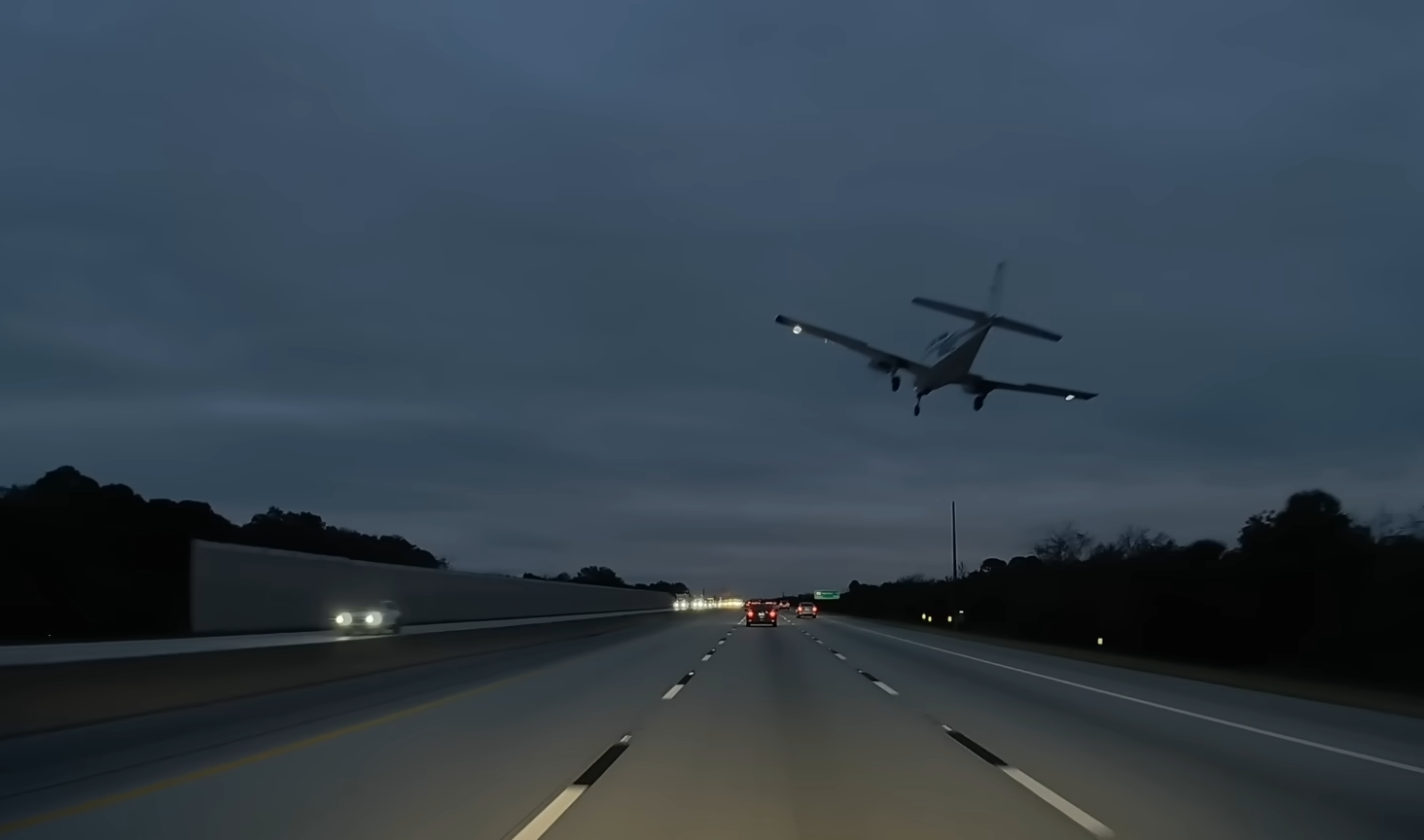
A small aircraft executed a forced emergency landing on a busy Florida highway during evening rush hour, resulting in a collision with a vehicle. The incident unfolded on the southbound lanes of Interstate 95 near Cocoa in Brevard County, just south of State Road 520 and around mile marker 201. Eyewitness dashcam footage captured the dramatic sequence, which has since circulated widely on social media platforms.
The Beechcraft 55, a twin-engine fixed-wing plane owned by Tailwinds Flying, had departed from Merritt Island Airport earlier that afternoon for an instructional flight. Shortly after takeoff, the pilot reported a sudden loss of power in both engines, prompting the decision to glide toward the interstate as the nearest viable landing site. As the aircraft descended around 5:45 PM on December 9, it struck the rear of a 2023 Toyota Camry traveling in the same direction, crushing the sedan and skidding to a partial stop against a concrete median barrier. Debris from the impact scattered across multiple lanes, briefly halting southbound traffic and causing significant delays for commuters between Orlando and Cape Canaveral.
Emergency responders from Brevard County Fire Rescue arrived promptly at the scene, where they extracted the Toyota’s driver and assessed all parties involved. The 57-year-old woman from Melbourne behind the wheel sustained minor injuries, including possible cuts and bruises, and was transported to Viera Hospital for evaluation and treatment. Remarkably, the 27-year-old pilot from Orlando and his 27-year-old passenger from Temple Terrace emerged from the aircraft unscathed, declining medical transport and remaining cooperative with authorities at the site.
The Federal Aviation Administration initially responded to the aviation aspects of the mishap, confirming the engine failure as the precipitating factor. The National Transportation Safety Board has since launched a formal investigation, classifying the event as an aviation accident due to the dual-engine power loss during flight. Meanwhile, the Florida Highway Patrol is conducting a parallel probe into the ground vehicle collision to determine any traffic-related contributing elements.
National Transportation Safety Board inquiries into aviation incidents, particularly those involving general aviation like small planes, follow a structured and collaborative protocol designed to enhance future safety without assigning blame. Upon notification—often within hours of the event—a “go-team” of specialists deploys to the site for immediate fact-gathering, including wreckage examination, witness interviews, and collection of flight data, maintenance records, and meteorological information. Participating parties, such as aircraft manufacturers, airlines, or regulatory agencies, assist under a formal system to pool expertise while maintaining independence.
Analysis occurs in phases, with investigators reconstructing the accident sequence through simulations, component testing, and expert consultations, culminating in a draft report that identifies the probable cause. This document undergoes internal review and may be presented at a public hearing if complex issues warrant broader input. Final reports, released publicly after board approval, typically emerge within 12 to 24 months, accompanied by safety recommendations directed at entities like the FAA to prevent recurrences—recommendations the board actively tracks for implementation. In this case, preliminary findings could appear within 30 days, though a comprehensive conclusion may take considerably longer given the instructional nature of the flight and potential maintenance factors.